Showing posts with label Post Dill. Show all posts

Monday, 30 September 2013

Resurrection. of a Dawn 611


 Back to almost fully operational. Just needs new thrust bearing to be fitted (on order) a new timber handle, and the pawl to be replaced.

In the restoration I wanted to preserve the antiquity of the drill rather than make it look like new which in my opinion would just make it look like a reproduction item rather than a genuine piece with history.


After some research this particular post drill is quite unique, and having spoken to a number of collectors it is believed to most probably be an original prototype.

The Dawn 611 post drill was made for 30 years and in that time there was one main modification which is on the shape of the cam on the drive gear and the length of the spindle which changed with the bearings going from a fibre washer (clutch plate) to a loose ball bearing thrust bearing. My drill clearly resembles the early cam version and has the Dawn Manufacturing co and 611 cast into the main body.  However there are many variations in my post drill that are not seen in any other 611 know to date.

  • The lug on which the ratchet is adjusted is flat not angled.
  • The feed wheel is spoked not solid and has a separate cast handle which is bolted on rather than being part of the wheel casting as one piece.
  • The Drive Gear is held on with a large bolt, not the standard shaft and pin arrangement. The Gear also doesn't have the T shaped slot which allows the pin to be removed.
  • The gears are recessed and not solid.
  • The coupler on the spindle has a large embossed A in the casting and doesn't have the boss on the side of it found on all others.
  • In the coupler and main body it is missing the oiler holes.
  • There are also differences in the diameter of shafts etc.

So It may just have been worth the time and effort to preserve.


Long live the POST DRILL!!!!


Near Miss!


The good news & the bad news.
I finally got the drill apart!


Which lead me to the bad.

While cleaning the spindle in the lathe the end of it grabbed my sleeve and pulled me in up to the armpit. before I could shut it down. I had a hell of a time getting myself free and although badly bruised and lacerated, (I do now have some scars) I was glad to have walked away from it with my arm still attached.


The Process


After the molasses and a bit of a scrub.


Rehabbing the post. With a run on the 8" grinder & wire wheel then a light sand in the lathe it has cleaned up but is still pitted in sections. I can live with it in the condition it's in. Can't look like new, needs a little life to show in it.


Main body in the Electrolysis bath.  Took several days, removed and cleaned then put back.
The spindle, and main gear are still stuck fast, Tighter than the proverbial Nun's C#$%


 Molasses and Electrolysis gave similar results the difference being the time factor. Neither will affect areas which have heavy grease and dirt build up. So a good scrub and degreaser is required first.

On the other hand a wire wheel rips into it.


Rusty Iron In a forms!


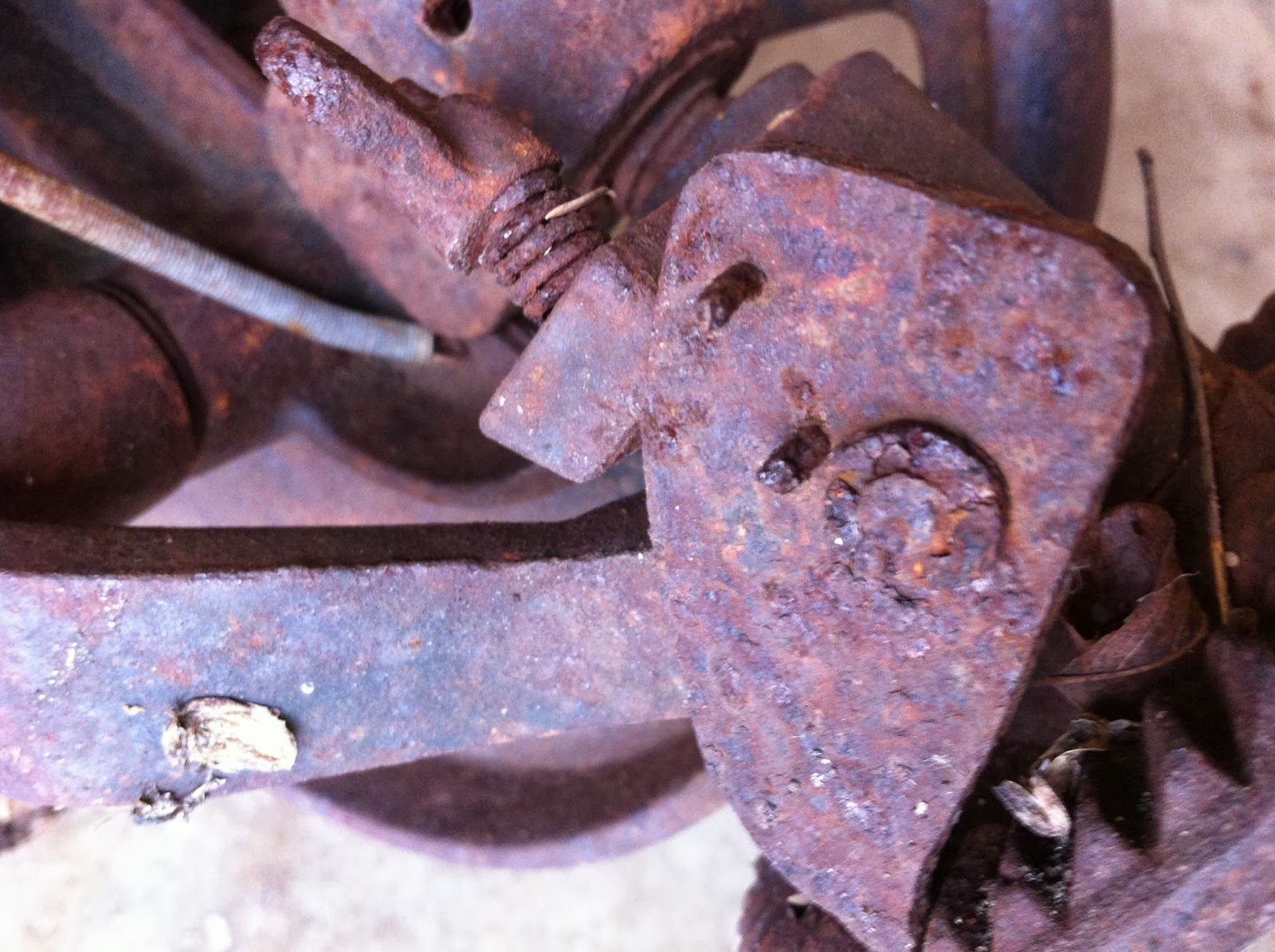
I picked up this old post drill, sometimes referred to as a blacksmith's drill.  It had been living in a costal town exposed to the elements for ages. It was sitting under some Tea trees, which are known for producing acid and the salt air which explain its "patina".  The whole thing was completely sized nd rust welded. Not a single part moved.

The disassembly alone took me 3 weeks working on it full time.This constituted exploring CR, WD40, G15, Kero, Molasses, Electrolysis, Wire wheel, A blow torch,  and a VBFH.


As you can see the casting was cracked and only that small clean corner was holding it together. I was quite shattered when it came apart.  However it was successfully welded back together!


The big mother of a bolt holds the main drive gear in place and is made of cast iron. The threads were damaged and I couldn't find a matching die to see if I could clean them up. The shaft was also no longer round due to wear from the hand cranking motion. So a new one was machined up and the thread cut on the lathe.